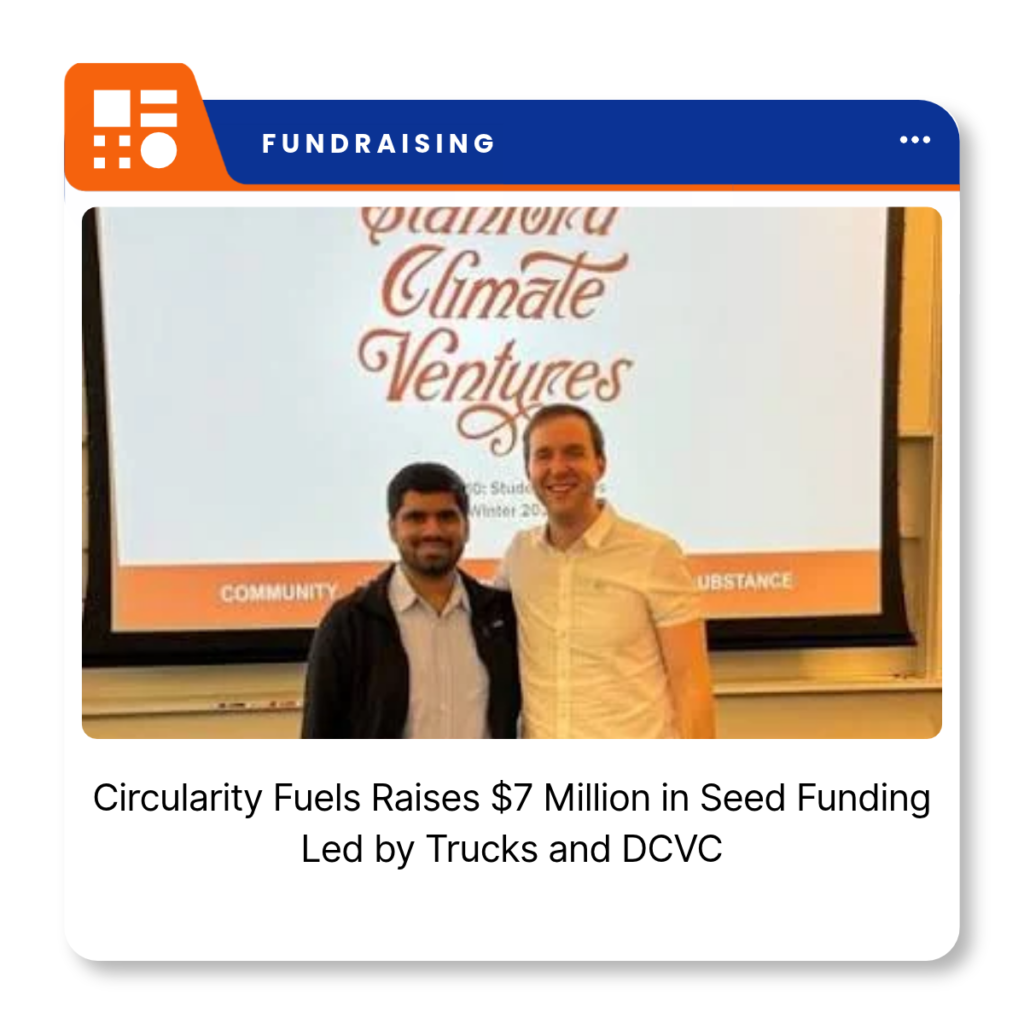

Circularity Fuels, a Redwood City, California-based renewable fuels technology startup, has raised $7 million in a seed funding round co-led by Trucks Venture Capital and DCVC. The round also saw participation from Sum Ventures and Automotive Ventures. The financing was announced on November 5, 2026.
Founded in 2023, Circularity Fuels is led by co-founders Dr. Stephen Beaton, CEO; Fergus Noble, CTO; and Gaurav Kamat, CSO. The company develops modular reactor systems designed to convert waste carbon and agricultural biogas into synthetic hydrocarbon fuels, with an initial focus on sustainable aviation fuel (SAF).
Its technology combines two reactor systems: the electrified Ouro reactor, which converts methane and carbon dioxide from biogas into synthesis gas, and the Aion Fischer-Tropsch reactor, which processes that gas into liquid hydrocarbons. The compact, skid-mounted systems are designed to support fuel production near agricultural and other waste-feedstock sources.
Circularity Fuels plans to use the new capital to build and operate a demonstration plant capable of producing jet fuel from biogas daily. The funding will also support engineering design for a commercial facility with a proposed capacity of 75 barrels per day, efforts to secure airline fuel supply agreements, and licensing of the Ouro reactor technology to external partners.
The company has outlined an 18-month development programme focused on advancing its technology from pilot operations toward commercial-scale plant design.
In June 2026, Circularity Fuels announced the completion of a six-month pilot at a dairy farm near Madera, California. The company reported that the integrated process converted raw dairy biogas into jet fuel meeting ASTM D7566 Annex A1 specifications, demonstrating the technology at pilot scale.
Following the seed round, Circularity Fuels reported approximately $17 million in combined venture financing and grant support. This includes nearly $7 million in grants from sources such as the US Department of Energy’s Advanced Research Projects Agency-Energy (ARPA-E) and the National Science Foundation.
The company previously emerged from DCVC’s incubation programme and is now pursuing demonstration-scale operations, commercial plant engineering and technology licensing as part of its next development phase.