
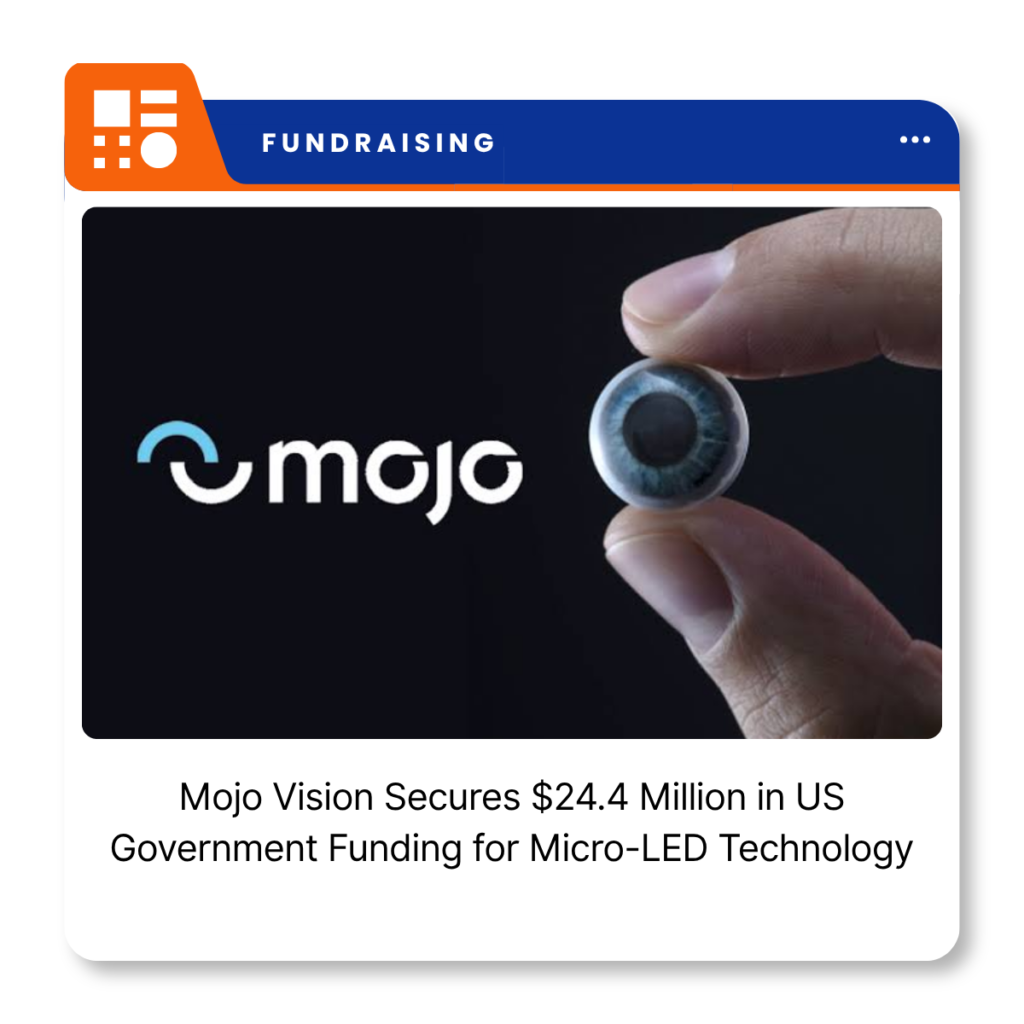
Mojo Vision, a Cupertino, California-based developer of micro-LED technology, has secured $24.4 million in US government funding to advance its semiconductor platform and develop full-color microdisplays for military augmented reality applications.
The funding was awarded under an Other Transaction Authority (OTA) agreement through the Office of the Assistant Secretary of War for Industrial Base Policy. The package comprises $20 million from the Industrial Base Analysis and Sustainment (IBAS) program and $4.4 million from the US Army’s Command, Control, Communications, Computers, Cyber, Intelligence, Surveillance, and Reconnaissance (C5ISR) Center.
Announced on October 21, 2026, the award is the company’s largest government funding commitment to date. It will support domestic manufacturing capabilities and the development of monolithic, full-color microdisplays for near-eye augmented reality systems.
Founded in 2015 by Drew Perkins, Michael Deering and Mike Wiemer, Mojo Vision initially developed augmented reality contact lens technology before shifting its commercial focus toward micro-LED displays and optical interconnects.
Led by CEO Nikhil Balram, the company develops a micro-LED platform built around 300mm silicon architecture, gallium nitride-on-silicon emitters, quantum dots, photodetectors and optical components. Its technology targets applications including AI glasses, advanced display systems and high-density optical interconnects for AI infrastructure.
The government-funded program will focus on developing high-brightness microdisplays using Mojo Vision’s quantum dot color-conversion technology. The displays are intended to improve visual performance and reliability while reducing equipment size, weight and power consumption. The development work will also cover semiconductor integration and wafer-scale manufacturing processes.
The government award follows a $17.5 million strategic investment from Future Ventures announced in March 2026 and a $75 million Series B Prime financing round in August 2025. The earlier investments supported the company’s micro-LED platform development and optical interconnect technology for AI computing infrastructure.