Cambridge Heavy Industries, a US-based fusion technology startup, announced $6.2 million in seed funding on October 22, 2026, led by Azolla Ventures. The round included participation from Overlay, the Massachusetts Clean Energy Center (MassCEC), Neta Foundation, the Rothrock family and P3A.
The Cambridge, Massachusetts-based company also announced its emergence from stealth as it advances the development of compact, laser-driven fusion systems designed for isotope production and potential future fusion power applications.
Founded in 2025, Cambridge Heavy Industries is led by co-founder and CEO Dr. Yun Kai, alongside co-founders Raffi Freeman, Professor Keith Nelson and Dr. Steve Kooi.
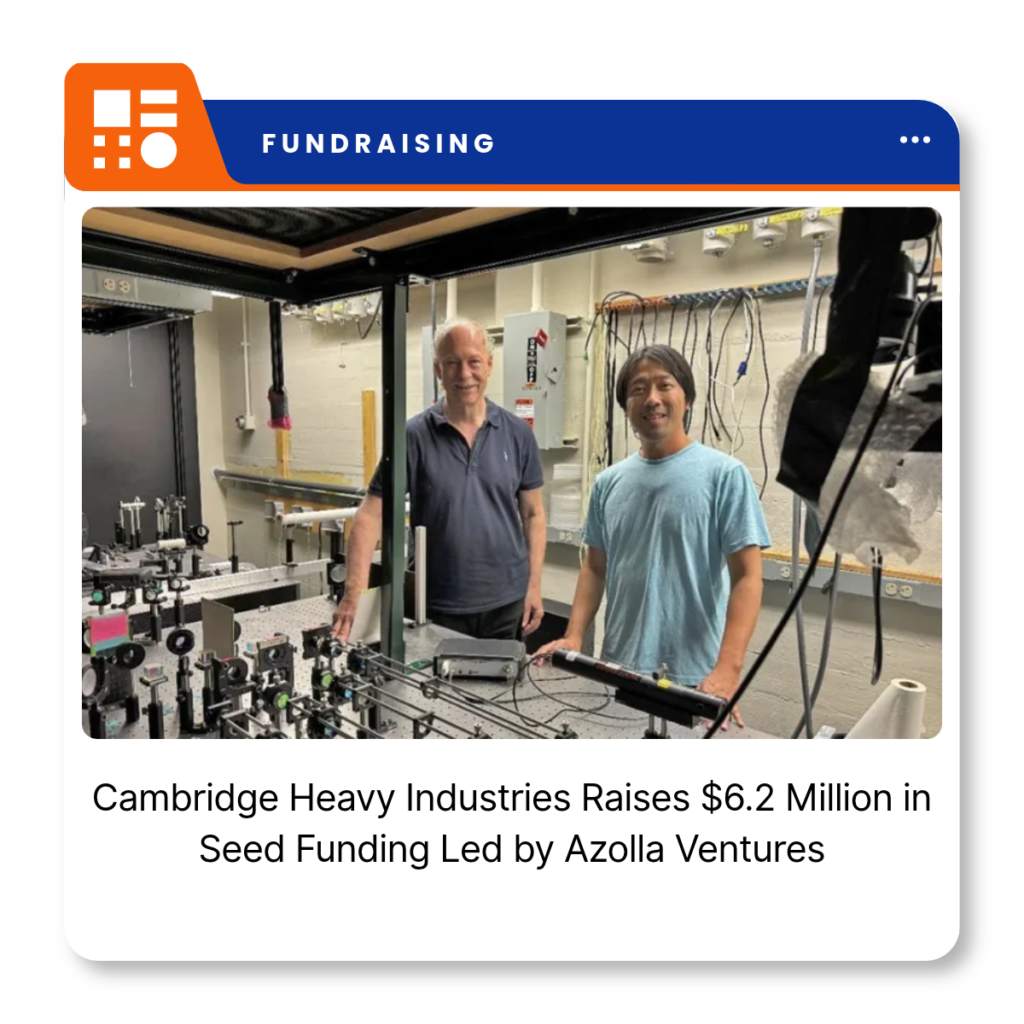
Spun out of the Massachusetts Institute of Technology’s Nelson Lab, the company is developing fusion technology based on laser-driven shockwaves. Its approach uses commercially available laser equipment to generate extreme pressures and temperatures required for fusion-related research.
The technology is designed to reduce the size and complexity of conventional laser-based fusion systems while allowing researchers to conduct experiments and modify equipment more frequently.
Cambridge Heavy Industries plans to use the new funding to construct its first compact fusion reactor at its Massachusetts facility. The investment will support the purchase of an ultrafast laser, optical components and neutron diagnostic equipment, alongside recruitment across research, engineering, simulation and business development.
The company’s initial commercial focus is tritium production. Tritium is a radioactive hydrogen isotope used as fuel in many proposed fusion reactor designs. Cambridge Heavy Industries aims to develop compact neutron sources capable of supporting tritium production, with additional potential applications in neutron imaging and materials engineering.
According to the company, its experimental system, approximately the size of two dinner tables, has demonstrated pressures reaching 350 gigapascals using tens of millijoules of laser energy. The result represents a high-pressure research milestone rather than a demonstration of commercial fusion electricity generation.
The seed investment will support further development of the company’s compact fusion technology as it works toward isotope production and longer-term fusion energy applications.