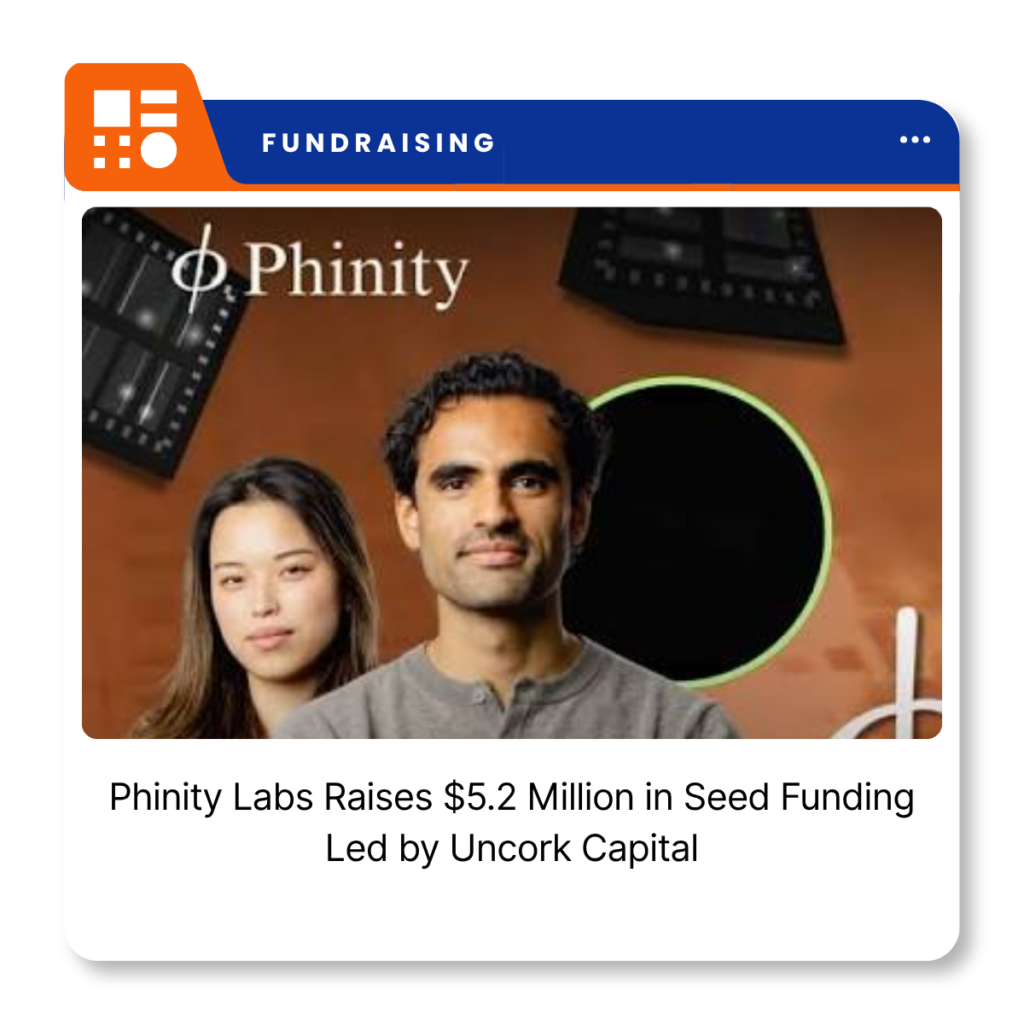
Phinity Labs, a San Francisco-based startup developing AI-powered systems for autonomous semiconductor design, has raised $5.2 million in seed funding led by Uncork Capital.
The round included participation from Moxxie Ventures and angel investors, including Google Chief Scientist Jeff Dean. The funding follows an earlier pre-seed investment led by Pear VC through its PearX accelerator programme.
Founded in 2025 by Sonya Jin and Aadi Nashikkar, Phinity Labs is developing AI agents capable of designing, evaluating and refining custom computer chip architectures. The company aims to automate semiconductor development, from initial architecture exploration and design verification to physical implementation and tapeout.
Its approach uses a closed-loop system in which AI agents generate hardware designs, evaluate their performance and make improvements based on physical feedback. The objective is to reduce the engineering time required to develop application-specific chips and enable broader exploration of potential hardware architectures.
Phinity Labs is building infrastructure to train AI models for semiconductor engineering rather than relying solely on existing coding assistants. Its technology targets chip design, verification and optimisation, with the longer-term goal of automating the complete development process.
The new funding will support the development of autonomous chip design agents, expansion of the company’s engineering capabilities and further investment in infrastructure for hardware evaluation and physical feedback testing.
According to the company, Phinity Labs has already reached an eight-figure annualized revenue run rate and established commercial relationships with major AI foundation-model laboratories. These engagements support its work on AI-assisted hardware development and semiconductor design automation.
Before founding Phinity Labs, Jin worked on synthetic data pipelines for chip design and code-reasoning models at NVIDIA and conducted graph machine learning research at AWS AI Lab. Nashikkar previously worked on synthetic data generation and AI model post-training and had founded an earlier startup.
The company is continuing to develop its autonomous semiconductor design infrastructure while expanding its team across AI research, hardware engineering and electronic design automation.