
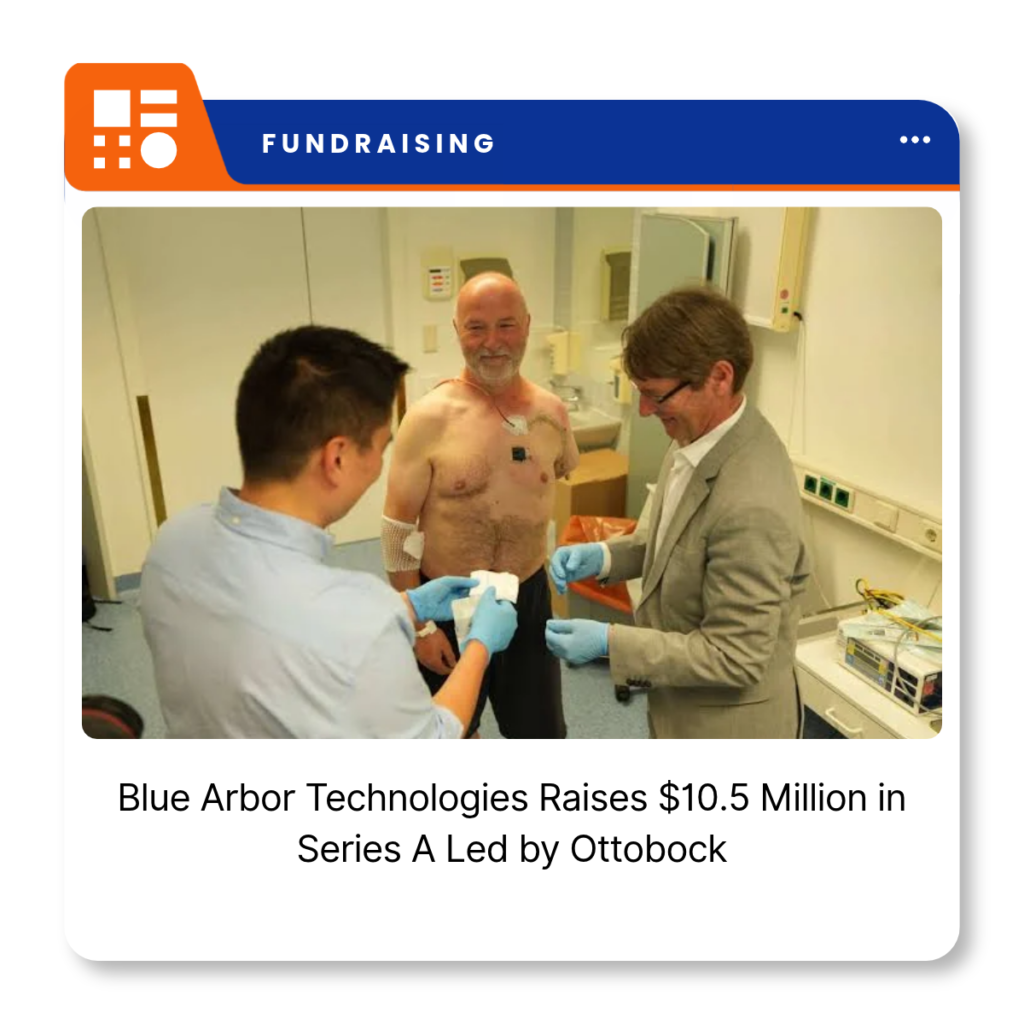
Blue Arbor Technologies, a US-based medical device company developing neuromuscular interfaces for prosthetic limb control, has closed a $10.5 million Series A financing round led by German prosthetics manufacturer Ottobock.
The funding follows a strategic partnership announced in February 2026, when Ottobock committed an initial $5 million investment to launch Blue Arbor’s Series A financing. Morningstar+1
Blue Arbor Technologies was founded by Dr. Paul Cederna, Dr. Theodore Kung and Dr. Alex Vaskov, who serve as President, Chief Medical Officer and Chief Technology Officer, respectively. The company is led by CEO Tod Borton and is based in Grass Lake, Michigan.
The company develops neuromuscular interfaces that connect signals from residual muscles and peripheral nerves to advanced robotic prosthetic limbs. Its RESTORE Neuromuscular Interface System is designed to enable independent and simultaneous control of prosthetic fingers, wrists and elbows, allowing users with upper limb loss to perform more complex movements. Blue Arbor Technologies+1
Blue Arbor is developing two versions of the RESTORE platform. The External Sensing Unit (ESU) is a wearable device that collects biological motor signals through implanted electrodes and transmits movement commands to a prosthetic limb. The Internal Sensing Unit (ISU) is a fully implantable version under development.
The company plans to use the Series A proceeds to complete feasibility testing, pursue an Investigational Device Exemption (IDE) from the US Food and Drug Administration to support clinical studies of the RESTORE ESU in the United States, and begin development of the RESTORE ISU.
Blue Arbor has reported two human implantations involving the RESTORE system, including a second procedure at the Medical University of Vienna. The company is also supporting a University of Michigan clinical study funded through a National Institutes of Health grant to compare surface and implanted electrodes for prosthetic control.
The RESTORE system has received FDA Breakthrough Device Designation and has been accepted into the agency’s Total Product Life Cycle Advisory Program Pilot. The technology remains investigational and has not received regulatory clearance or approval for commercial distribution.