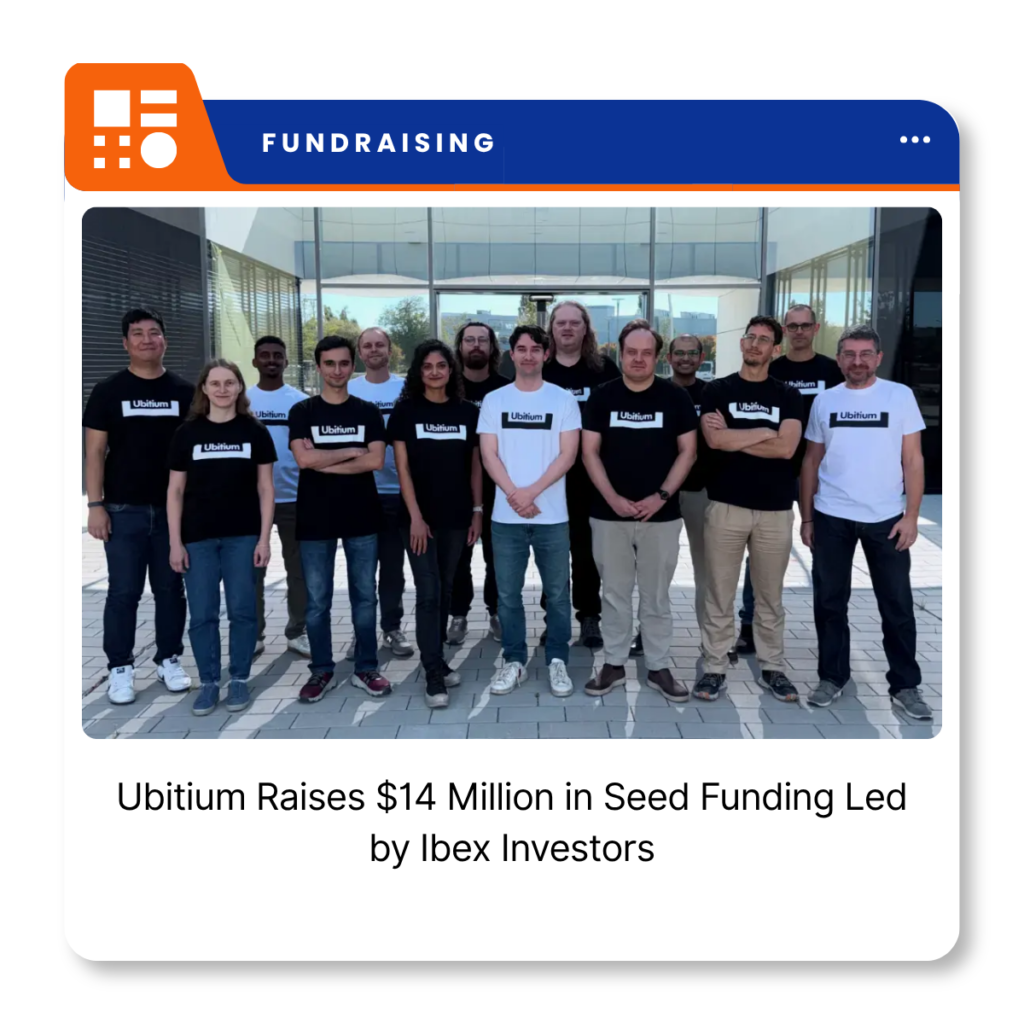
German semiconductor startup Ubitium has raised $14 million in seed funding in a round led by Ibex Investors. The investment included participation from OpenOcean, existing backers KBC Focus Fund, Runa Capital and Inflection, alongside Florian Seibel, co-founder and co-CEO of Quantum Systems, who invested personally.
The financing brings the Düsseldorf-based company’s total seed funding to $18 million since its establishment in 2024.
Founded in 2024 by Hyun Shin Cho and Martin Vorbach, Ubitium develops reconfigurable semiconductor processors for physical AI applications. Its technology is designed to combine signal processing, AI inference and real-time control within a single processor architecture, reducing the need for multiple specialised chips in autonomous machines.
The company’s processor uses a reconfigurable RISC-V architecture that can allocate computing resources across different workloads during operation. Ubitium is targeting embedded systems and autonomous applications, including robotics, drones, industrial equipment and vehicles.
Ubitium has developed its first chip, the UB108, featuring 256 processing elements and manufactured using Samsung’s 8-nanometre process. According to the company, the chip has demonstrated signal processing, AI inference and real-time control operating on the same reconfigurable array.
The startup also reports holding 17 granted patents covering its core technology, with additional patent applications pending. Its technical team has experience across semiconductor development and reconfigurable computing.
Following the latest financing, Ubitium plans to advance development of its first commercial processor, the UB410, which is designed to contain 4,096 processing elements. The company expects to tape out the processor and deliver evaluation units in 2027.
Its initial customer applications include high-resolution radar and audio systems that require signal processing and AI capabilities on a single processor. The company is also targeting autonomous systems, including drones, as longer-term applications for its processor architecture.